Workshop 2
Workshop on Distributed Storage Systems and Coding for BigData
http://bigdata2014stanford.scienceengineering.org
Goals of the workshop
The Distributed Storage Systems and Coding for BigData Workshop at ASE BigDataScience 2014 aims to disseminate the latest developments and advancements in these emerging focus areas. Contributions devoted to the evaluation, optimization, or enhancement of distributed storage systems, as well as solutions for mass storage, are solicited. The overall goal is to present the latest snapshot of the ongoing research as well as to shed further light on future directions in this research field.

Duration of the workshop
Half-day or one day depends on the regular papers accepted.
Significance of the workshop
Mass data storage is critical in the era of BigData, which is transforming science, engineering, medicine, healthcare, finance, business, and ultimately society itself. Dispersing a huge data file in a large-scale distributed storage system is necessary in order to enhance reliability and availability. By introducing redundancy in the system, we can protect the data integrity from node failures. As node failures occur frequently in large-scale storage system, a considerable volume of Internet traffic is dedicated to the repair of failed storage nodes. Several classes of distributed storage codes, such as regenerating codes, locally repairable codes and so on, are introduced recently to reduce this overhead and disk input/output cost. Nevertheless, there still remains substantial research work for advancing distributed storage coding and systems in both theory and applications. This workshop will provide a platform for academic researcher and industrial engineers to discuss and share their recent works and practical experiences.
Planned format of the workshop
The workshop will include paper presentation section, keynote speeches ("Network coding theory" by Prof. S. Y. Robert Li, The Chinese University of Hong Kong; "Efficient Coding Schemes for Bigdata in Distributed Storage Systems" by Prof. Hui Li, Peking University) and panels, and we are now waiting for the other speaker’s reply.
Research topics included in the workshop
Contributions devoted to the evaluation, optimization, or enhancement of distributed storage systems, as well as solutions for mass storage, are solicited. The overall goal is to present the latest snapshot of the ongoing research as well as to shed further light on future directions in this research field. Authors are invited to submit papers presenting novel technical studies as well as broader position and vision papers comprising hypothetical/speculative scenarios.
The planned workshop topics of interest include, but are not limited to, the following:
- Cloud storage and distributed storage system
- Erasure Codes for BigData
- Distributed I/O (wide-area, grid, peer-to-peer)
- Experience and empirical evaluation of deployed systems
- Solid-state drive (e.g., flash, PCM) in large-scale storage
- RAID and erasure coding
- Repair bandwidth and regenerating codes
- Locally repairable codes
- Storage management and security
- Power-aware storage architectures and technologies
- File system design
- Deduplication
- Key-value and NoSQL storage
- Memory-only storage systems
- Reliability, availability, and disaster recovery
- Search and data retrieval
A description of the publicity and promotion plan
Besides the workshop website, we will also publish news on the homepage of Peking University, The Chinese University of Hong Kong as well as other public forums. We are now just carrying a National Basic Research Program of China (No. 2012CB31900) with funding 30M RMB. About ten famous universities or institutes in China take part in this project, they will submit papers to report the progress of research on various directions.
Important dates
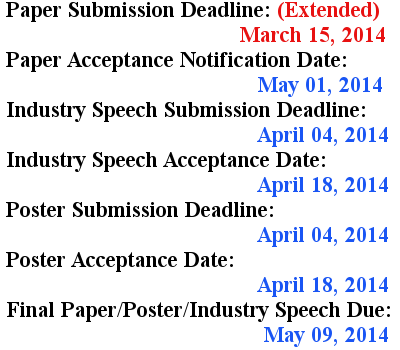
- April 1, 2014: Due date for full workshop papers submission
- April 30, 2014: Notification of paper acceptance to authors
- May 7, 2014: Camera-ready of accepted papers
- May 27, 2014: Workshop
The paper selection process
Each submitted paper will be reviewed by at least three program committee members (some may have even more). All the paper decisions will be made from the weighted scoring of the reviewing reports. If there is any question for paper submission, please contact [email protected]
Paper Submission: Online Submission
Workshop Registration: Online Registration
A description of past versions of the workshop
We have successfully held the first Workshop on Distributed Storage Systems and Coding for BigData at the IEEE International Conference on Big Data 2013 (IEEE BigData 2013). We received a total of 28 submissions from all over the world, and the final acceptance rate is 32%. Papers went through a rigorous review process. Each paper was reviewed by at least three program committee members. All accepted papers are presented at the workshop. More than 30 researchers and scholars have attended this workshop.
More details about the workshop can be seen at: http://www.ece.pku.edu.cn/workshop/2013_Bigdata/.
Names of potential participants
General Chairs:
- S. Y. Robert Li, The Chinese University of Hong Kong, Hong Kong
Professor Shuo Yen Robert Li, Fellow IEEE, received his PhD from UC Berkeley in 1974, taught Applied Math at MIT in 1974-76 and Math/Statistics/CS at UI Chicago in 1976-79, and then worked on switching systems and theoretic research at Bell Labs/Bellcore for a decade. He has been a Chair Professor at CUHK since 1989 and currently also serves a Professor (by courtesy) in Mathematics and a Co-director of Institute of Network Coding. Meanwhile, Professor Li is a “111 Great Master of Science” for the IGAT Program of China as well as an honorary professor at 8 major universities, including 5 for lifetime.
Professor Li cofounded the theory of network coding, which is currently a very active research field worldwide. He is a Principal Investigators of a research grant from the Hong Kong government in the amount over HK$100M. The L-Y-C paper “Linear Network Coding” won the IEEE Information Theory Society Paper Award of the year 2005. Professor Li also started the field of algebraic switching with his book “Algebraic Switching Theory and Broadband Applications.” The algebraic switching fabric has been adopted by the major project “Metro Switch” of ITRI in Taiwan. His earlier paper on martingale of patterns engenders a research area with applications to genetics and other fields. He holds 32 US patents so far and is a 4-time winner of Outstanding Paper Award from ITRI.
Co-Chairs:
- Hui Li, Peking University, China
- Kenneth W. Shum, Institute of Network Coding, the Chinese University of Hong Kong, Hong Kong
Names, addresses, and a short CV of the organizers
Hui Li received the B. S. and M. S. degrees from Tsinghua University, Beijing, China, in 1986 and 1989 respectively, and the Ph.D. degree from the Chinese University of Hong Kong in 2000. He is now a Professor of School of Electronic and Computer Engineering, Peking University. His research interests include network coding theory, distributed storage coding and system, network architecture, broadband switching and routing.
Address: Room A212, Building A, Peking University Shenzhen Graduate School, Shenzhen University Town, Shenzhen City, 518055, China
Email: [email protected]
Tel: (+86)755-26035354
Fax: (+86)755-26032015
Program Committee Members:
- Ming Xiao, Royal Institute of Technology, Sweden
- Minghua Chen, The Chinese University of Hong Kong, Hong Kong
- Shujiang Zhao, Huawei Technology, China
- Patrick P. C. Lee, the Chinese University of Hong Kong, Hong Kong
- Ke Chu, ZTE Corporation, China
- Kenneth W. Shum, Institute of Network Coding, CUHK, Hong Kong
- Xiao MA, Sun Yat-sen University, China
- WaiHo MOW, Univ. of Science and Technology, Hong Kong
- Yuesheng Zhu, Peking University, China
- Manish K Gupta, Dhirubhai Ambani Institute of Info.& Comm. Tech.(DA-IICT), India
- Salim El Rouayheb, Illinois Institute of Technology, USA
- Xin WANG, Fudan University, China
- Jianshe MA, Tsinghua Univ., China
- Yinlong XU, University of Science and Technology of China
- Qiang Cao,Huazhong University of Science and Technology
- Hui Li, Peking University, China





Leave a Reply